Speed Kills
How much is speed worth?

As someone who grew up in suburbia and then moved to a dense City (s/o Chicago), I've thought a lot about how we get around. What vehicles, if any, we use. If they're privately or publicly owned. Especially in a big city, the options are more numerous than you may think.
You can walk. And you should, if you're able. It's very healthy for you. You could run or jog too, though likely less common for commuting. You could bike with your own bike. Or you can rent a bike (Divvy/Citibike), or you could rent an e-bike. Or you could own an e-bike. You could scooter, often from a variety of providers too. You can of course drive, or ride in the case of a motorcycle or Vespa. Or you could be driven by someone else in a Taxi or Uber. And coming soon, you could be driven by no-one in a driverless car. Waymos have already hit the streets of Chicago for training (and are live in many other cities in the US). You could also rely on public infrastructure assuming your city has any. Commonly that looks like a bus taking public roadways or a subway/tram/monorail taking on its own infrastructure. Some people also rollerblade or skateboard and many other more niche options.
I haven't owned a car in years and so my main mode of transport is an e-bike or public transit. And I mostly enjoy it, especially in the summers. But I see a lot of public roads and how slow certain modes of travel can be, how dangerously fast others can be at times. And it often brings up for me thoughts of efficiency and speed. How fast is too fast? How fast is fast enough?
Approximately 7,500 pedestrians are killed by cars each year. Another 60,000+ are injured. And most of the deaths are related directly to speed.1
Exact stats can vary but a quick Google search can pull up many stats that converge on this basic plot:

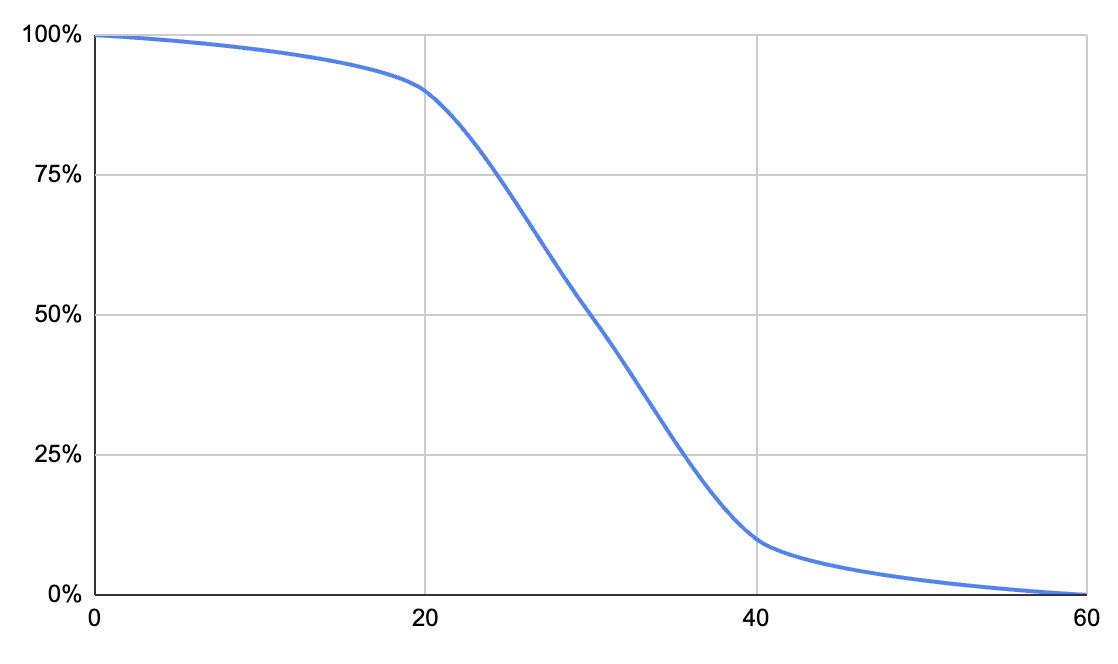
The X axis is the miles per hour a vehicle is traveling. The Y axis is the percentage survival chance of a pedestrian hit at that speed.
Roughly the stats are:2
- 0 mph = ~100% chance of survival (😱)
- 20 mph = ~90% chance of survival
- 30 mph = ~50% chance of survival
- 40 mph = ~10% chance of survival
- >60 mph = little chance of survival
Where this becomes fascinating is when plotting the benefits of traveling faster alongside this. By the nature of increasing speed relative to staying stationary, each additional increase in miles per hours yields fewer returns on how fast you get to your destination. This is especially true when talking about daily commuting distances, we'll use 10 miles as an example.

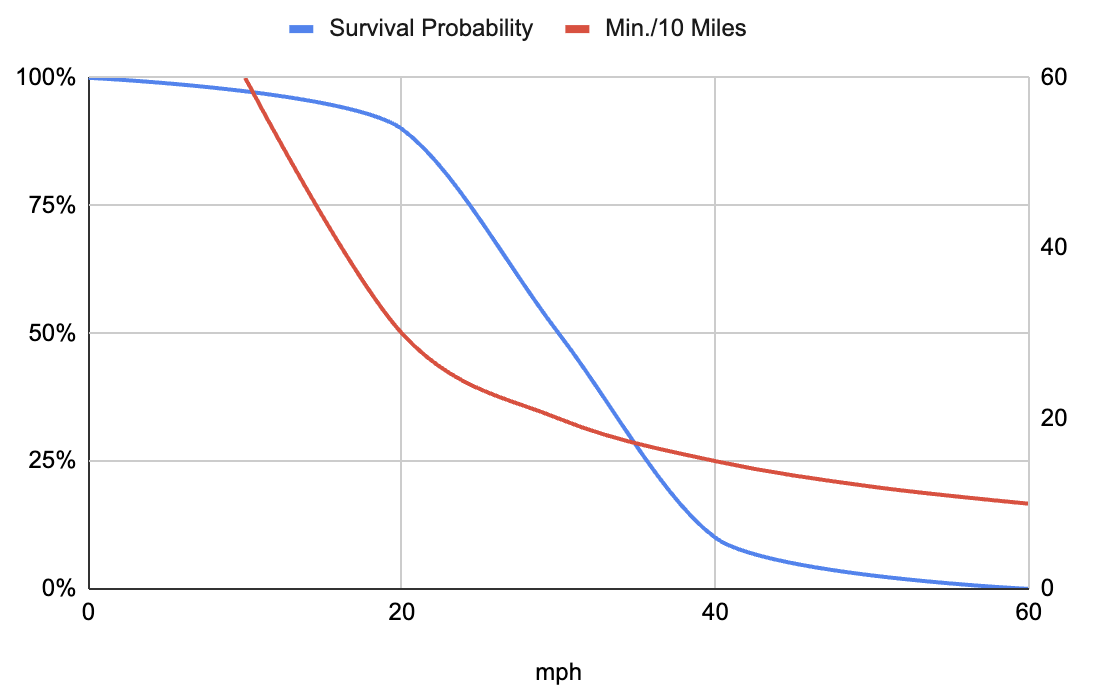
The difference in returns here is staggering. Driving 10 mph faster from 10mph to 20mph, halves the time it takes to drive 10 miles, from 60 minutes to 30 minutes. But increasing your speed the same increment, from 50 mph to 60 mph, saves only 2 minutes. And specifically in the middle, decreasing from 40 to 30 mph, costs only 5 minutes. Likewise 30 to 20 mph, costs 10 minutes for a 10 miles trip.
Compare this to the gains in pedestrian survival rates at the same increments. 50 vs 60 mph changes almost nothing, the pedestrian is unlikely to survive. Change from 0 to 10 and similarly, the pedestrian has an extremely high survival rate. But in the middle the story is not the same. Decreasing speed from 40 to 30 mph, results in a 40 percentage point increase in pedestrian survival. Likewise, 30 to 20 mph, jumps pedestrian survival to 90%. The gains are not the same. What costs only 5 or 10 minutes, radically changes the outcome for a pedestrian who's hit at those speeds. (Btw, in principle survival rates for anyone involved go up as speeds go down - driver, passengers, pedestrians, cyclists, motorcyclists, dogs. The principle remains).
Speed matters, we all can't go around at a snail's pace conducting our lives. But the question of how much speed matters in the face of speed killing is an interesting question I wrack my brain with occasionally.
As a thought experiment, suppose a genie or a witch cursed you such that if you ever drove faster than 20 mph, you'd die. Surely, you'd stop driving anywhere close to 20 mph! You might resort to walking or taking the bus just about everywhere. But what if I dropped it to 50% chance you'd die. What about now? Still driving slow? What about 10%? What about if it wasn't you but a family member? A friend? A stranger? What if it's 0.001% chance some random stranger you'd never met dies? How close to the stats of reality do we have to get for speed to be more worth it? It's a thought experiment, I don't know what my answer is. But speed does kill, so it's worth thinking about how fast is fast enough for you.
- These numbers have been rising more dramatically than you might think. See https://www.nhtsa.gov/book/countermeasures-that-work/pedestrian-safety.
- These are generalizations. Exact studies have slightly different numbers. See https://carsp.ca/en/news-and-resources/road-safety-information/safe-speeds/, https://www.alltrafficsolutions.com/blog/traffic-calming-measures-to-save-pedestrian-lives/, https://trafficsafety.sites.unlv.edu/trend-14-1-slowing-down-for-safety-addressing-the-impact-of-speeding/, https://www.tampa.gov/visionzero/citywide-speed-limit-reduction-program.